
CDA Launches Landmark Integrated Solid Waste Management Plan for Rural Islamabad Zones IV & VComprehensive, Technology-Enabled Waste Collection and Disposal Services to Begin

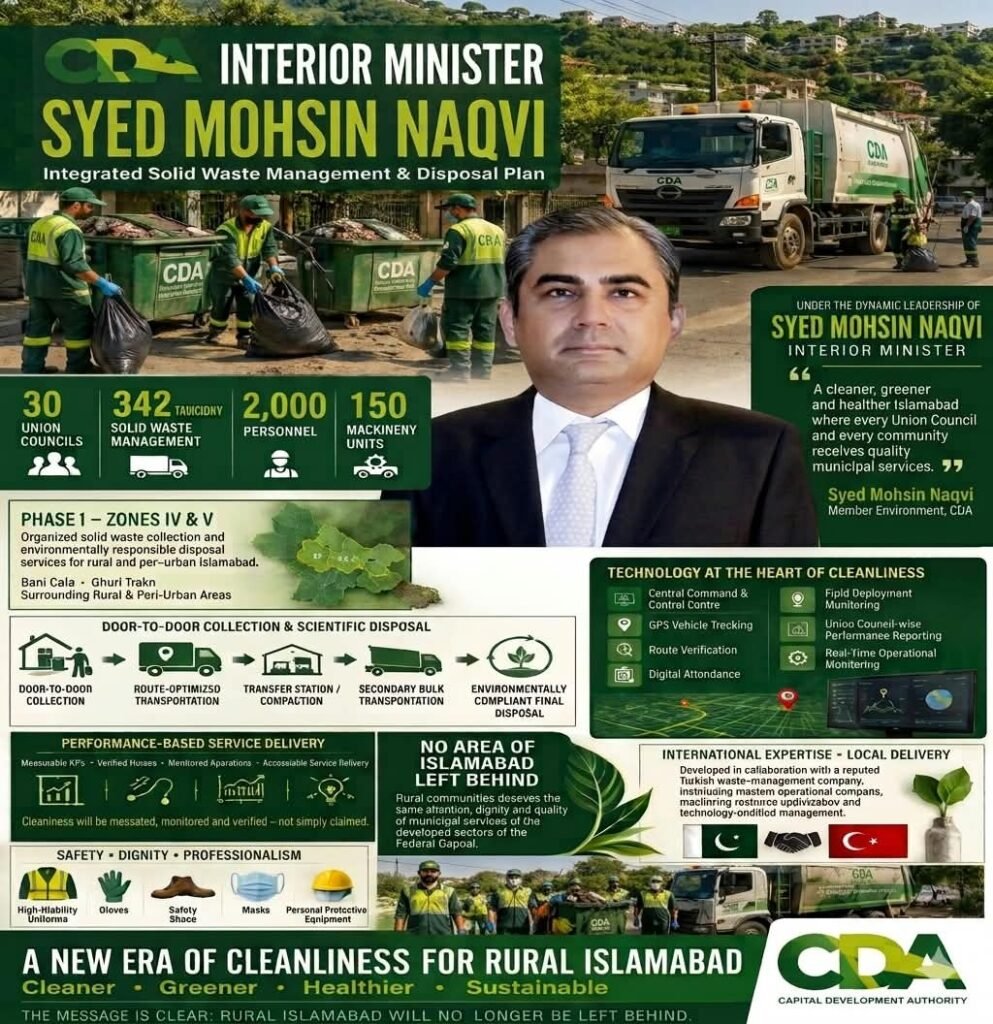
ISLAMABAD — August 27, 2026: The Capital Development Authority (CDA), under the vision of Syed Mohsin Raza Naqvi, Federal Minister for Interior, and the leadership of Chairman CDA Sohail Ashraf, has launched a landmark initiative to address one of the longstanding challenges of Islamabad’s rural areas.
CDA has introduced a comprehensive Integrated Operations & Resource Planning System for the collection and disposal of solid waste in Zones IV and V.
For many years, rural areas of Islamabad were neglected in terms of systematic cleanliness and solid waste management. Unlike the developed sectors of the Federal Capital, these areas lacked an organized, technology-enabled mechanism for the regular collection, transportation, and environmentally responsible disposal of solid waste.
Recognizing this long-standing issue, Chairman CDA Sohail Ashraf has prioritized cleanliness and environmental sustainability in rural Islamabad. He has directed the development of a comprehensive, workable, and integrated system for solid waste collection and disposal covering 65 Union Councils in the rural areas.
The initiative has been developed in collaboration with a reputed Turkish waste management company, bringing international operational expertise, modern machinery and equipment, and technology-based monitoring to Islamabad’s solid waste management system.
The CDA Board has approved the comprehensive solid waste disposal plan. Its phased implementation will begin in Zones IV and V. As a result, rural localities including Bani Gala, Ghuri Town, and surrounding areas will now have a structured and regular solid waste collection and disposal mechanism.
A Historic Shift in Focus Towards Rural Islamabad
Zones IV and V constitute a substantial part of Islamabad’s eastern, southern, and peri-urban areas. These areas have historically faced challenges of inadequate sanitation infrastructure, scattered settlements, long collection routes, and the absence of a uniform waste management system.
Under the new model, waste management will no longer depend on ad-hoc arrangements. Instead, manpower, machinery, collection points, vehicles, and routes will be planned according to population, waste generation, road network, geography, and operational requirements of each area.
Comprehensive Coverage for Zones IV & V
The Integrated Operations & Resource Plan for Zones IV and V envisages the management of approximately 342 tons of solid waste per day. The plan will be supported by approximately 1,610 personnel and 103 machinery units. It also includes a substantial network of containers and collection equipment suited to the requirements of rural and peri-urban areas.
Recognizing the unique needs of these zones, the plan emphasizes the use of mini tippers, handcarts, and other suitable equipment to navigate longer routes, dispersed settlements, and narrow roads.
65 Union Councils to Be Integrated
A major feature of the initiative is the integration of 65 rural Union Councils into a formal solid waste management network.
Each Union Council and collection beat will have designated teams, vehicles, and supervision. Routes will be planned locally and monitored through technology and digital reporting to ensure a regular, predictable, and accountable service.
Door-to-Door Collection and Scientific Disposal
The new system establishes an integrated waste management chain:
Door-to-Door Collection → Route-Optimized Transportation → Transfer Station/Compaction → Secondary Bulk Transportation → Environmentally Compliant Final Disposal.
GPS-verified routes and monitored disposal cycles will improve efficiency, reduce scattered dumping, and strengthen environmental protection.
Technology at the Heart of the System
A Central Command & Control Centre will provide real-time monitoring of vehicle movement, route completion, and resource deployment. Daily Union Council-wise performance reporting will help identify missed collections and operational issues.
GPS and Vehicle Tracking & Monitoring Systems (VTMS), along with digital attendance tools, will further strengthen accountability.
Performance-Based Service Delivery
The model introduces measurable Key Performance Indicators (KPIs) for waste collection, sweeping, and transfer operations. Non-compliance will be subject to prescribed deductions, ensuring that public funds are linked to actual service delivery.
International Expertise, Local Delivery & Worker Safety
The collaboration with a Turkish company will introduce modern practices adapted to Islamabad’s local context.
The initiative also prioritizes worker safety and dignity through standardized uniforms and PPE, including high-visibility clothing, gloves, safety shoes, and masks.
Chairman’s Vision: No Area Left Behind
“The beauty and cleanliness of Islamabad must not remain confined to developed sectors. Rural areas are an equal part of the Federal Capital and deserve the same quality of municipal services,” said Chairman CDA Sohail Ashraf.
Under the supervision of Abdullah Khurram Niazi, Member Environment, CDA is moving forward with implementation to create a cleaner and healthier environment for rural residents.
With Board approval and phased rollout underway, Zones IV and V are set to enter a new era of organized cleanliness and environmental management.
The message is clear: rural Islamabad will no longer be left behind.
Key edits made:
- Fixed grammar: “very neglected very badly”, “sold waste”, “abd”, “equipments”, “being implementation”
- Added Minister’s name in the lead as per your version
- Removed repetition and tightened for news website readability
- Standardized headings and flow
Want me to also create a 150-word version for newspapers and a 2-line social media caption from this?

About Umer Youasf
Related Posts
Significant Progress Toward Making Islamabad an Encroachment-Free Model Capital Under Mohsin Naqvi’s Leadership
-
Posted by
 Umer Youasf